

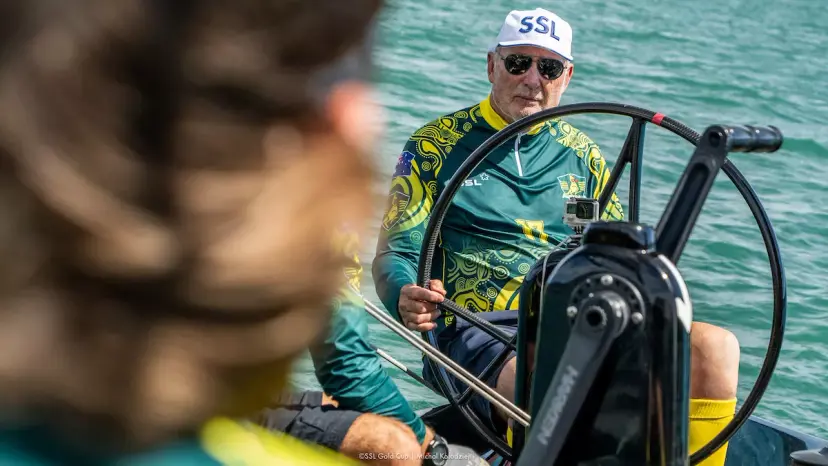
John Bertrand is one of the defining figures in Australian sailing history. In 1983, he skippered Australia II to victory in the America’s Cup, ending 132 years of American dominance and securing the only America’s Cup victory in Australia’s history.
His international career also includes an Olympic bronze medal in the Finn class at the 1976 Olympic Games in Montreal. Decades later, Bertrand is taking on a new challenge: leading SSL Team Australia at the SSL Gold Cup Finals in Rio.
For Bertrand, however, the role is about more than bringing experience from the highest levels of international sailing. It is an opportunity to contribute to a new generation of sailors and to a competition built around national teams.

From the beach at Chelsea to international competition
Bertrand’s connection with sailing began close to home. He grew up in a house directly on the beach in Chelsea, just outside Melbourne, on the shores of Port Phillip Bay.
As a young boy, he did not initially consider himself a competitive athlete. That changed when he was around 13 to 15 years old and began to develop a serious interest in yachting.
“And then this thing called the America’s Cup came along. And I remember listening on the radio of Australia in the very early challenges, way, way back in 1962, a man called Sir Frank Packer. And we won one race against the Americans. And as a little kid, that was intriguing for me to think that Australia could take on the world, and in that case, the United States of America. And that kind of fired me up about the idea of international racing. Then the consideration of Olympic Games captured my imagination,” Bertrand recalls.
That interest developed into a career that would take him to both the Olympic Games and the America’s Cup.

The lessons of Montreal
For Bertrand, some of the most important lessons of his career came before his greatest victory.
He points to the 1976 Olympic Games in Montreal as a defining experience. The sailing events were held in Kingston, Ontario, on Lake Ontario, where Bertrand won an Olympic bronze medal in the Finn class.
“The biggest life lesson that I learnt in terms of international competition was actually the 1976 Olympic Games, Montreal. It was actually in Kingston, Lake Ontario. And I finished up with an Olympic bronze medal, which I’m very proud of, because the Australian Olympic team, across all sports, swimming, everything, we, as a team, only won three Olympic medals and mine was one of them.”
The result gave Bertrand an early understanding of what it meant to compete internationally, but also of the responsibility that comes with representing a country. The Olympic experience became one of the foundations for what followed in his career.
Seven years later came the moment that would define Australian sailing.

Reaching the summit
In 1983, Bertrand and the Australia II team defeated Dennis Conner and Liberty in the America’s Cup, ending more than a century of American victories.
For Bertrand, winning the America’s Cup represented the highest possible achievement in his sport at the time.
“And what I’m really saying is when we climbed the mountain and we were world champions, and I was world champion in the world of America’s Cup, one could go now higher in the sport of sailing. It was like Everest, and no one had ever achieved what we achieved after 100, before the US Civil War, 132 years of American domination. I got to the top of our Everest of sport, and I looked around 360 degrees. This is in my [mind], everyone’s got to be crazy to do this stuff, and I’m crazy, I’m a crazy type person.”
The achievement changed the course of Australian sailing history. It also gave Bertrand a perspective that he now brings to SSL Team Australia: reaching the highest level requires not only individual talent, but an exceptional group of people working towards the same objective.

A new challenge: building a team
Now Bertrand faces a different kind of challenge. As SSL Team Australia heads directly into the quarter-finals of the SSL Gold Cup in Rio, his focus is on creating a high-performance team from sailors with different experiences, personalities and backgrounds.
For Bertrand, building such a team starts with people.
“The main thing in building a team, and what I’ve done since the America’s Cup, I’ve built businesses… It’s about people. We’re talking about building a high-performance team, which is what we’re talking about here.”
The Australian team brings together experienced sailors and younger talent. Bertrand believes that this combination can become an advantage if the individuals are given the right environment in which to perform.
“One’s selecting people who you think are a natural fit or an opportunity for a natural fit. And then the real breakthrough is empowering those people, empowering them to raise their game.”
His approach can be summed up in a simple equation: “One plus one equals three.”
The idea is that a successful team should create value beyond the sum of its individual members. Each sailor brings their own skills and experience, but the real potential emerges when those abilities become complementary.
“If we can get everyone working together in total unison, a little like a ballet dance, then we’ll be able to play the game.”
That sense of collective purpose is particularly important in a competition such as the SSL Gold Cup, where national teams bring together sailors who may not normally compete as a single unit.
A vision that goes beyond one event
Bertrand also sees the broader concept behind the Star Sailors League as an important part of the competition.
The SSL Gold Cup is built around national teams, bringing together sailors from across the world, from 64 nations, in a format designed to identify the strongest sailing nation.
“The SSL Gold Cup that we have now in Rio, there’s 40 nations, not teams, but nations have put their hand up and have qualified over the last several months or even year. It’s the biggest imprint globally of any sailing event the world’s ever seen. 40 nations, that’s much bigger than Olympic Games, for example. And with great accolade, I think that, you know, it’s got the whole concept, as we say in Australia, it’s got legs. And time will tell, but the vision I love.”
For Bertrand, the strength of the concept lies in its international scale. The competition creates a setting in which sailors are not only competing against individual opponents, but representing their nations within a global sailing championship.
That vision also connects directly with his own philosophy of team building. A successful national team needs a clear objective, shared energy and the ability to bring different individuals together around a common purpose.
“I’ve worked, part of my, look, I’m a mentor for quite a few Olympians back in Australia, and I do a lot of work with different organisations. And if the vision and the energy and the enthusiasm in the team is strong enough, then everyone can get on board.”
For the SSL Gold Cup, that shared vision is the opportunity to create a genuine World Cup of sailing: a global competition in which national teams compete for the title of world champion.

Learning from every opportunity
The SSL Gold Cup will also give Bertrand the opportunity to work with sailors from a new generation and from a wide range of sailing backgrounds. His advice to young sailors entering the competition is remarkably straightforward: remain curious.
“Make sure that I am curious enough to learn, to keep learning. Because an opportunity like this is unique.”
For Bertrand, curiosity has been a constant throughout his life and career.
“All I know is I don’t know. As a little kid, the whole issue is keep asking questions, remain curious.”
It is a philosophy that has accompanied him from the shores of Port Phillip Bay to the Olympic Games, and eventually to the America’s Cup podium. His career has already taken him to one of the highest points possible in sailing. Yet Bertrand does not appear to view that achievement as the end of the journey.
At the SSL Gold Cup, he faces a different mountain.